
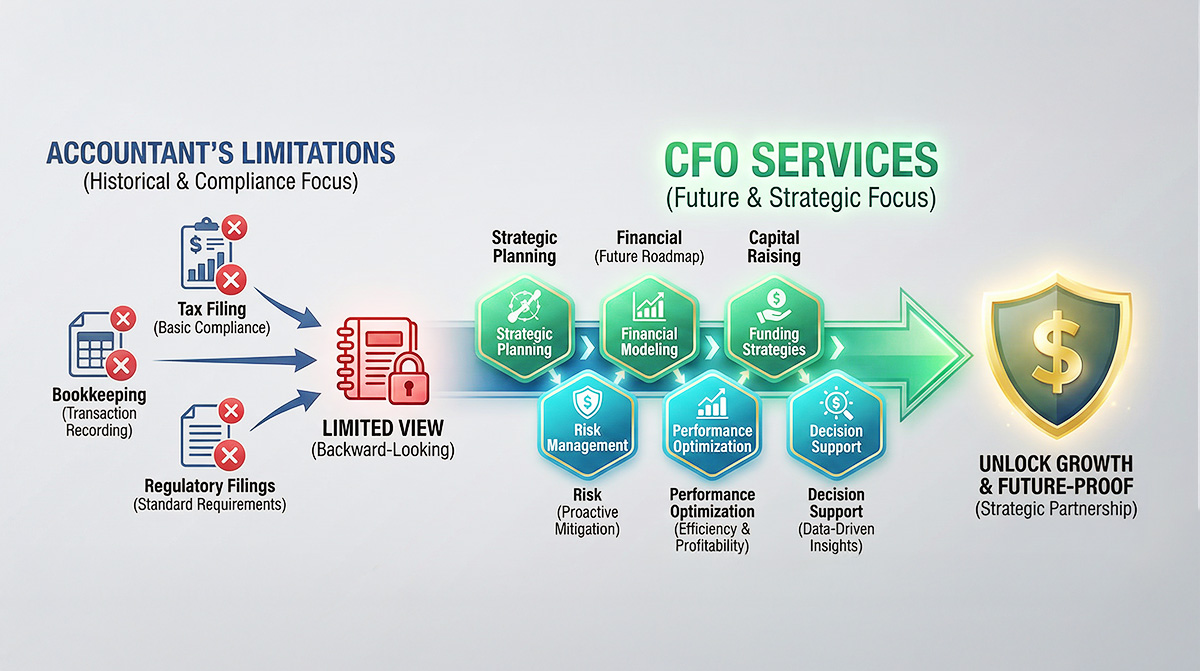
Most small businesses rely on an accountant or bookkeeper—but few have access to the kind of strategic financial leadership a CFO provides. A fractional CFO bridges that gap, helping businesses grow with clarity and confidence.
1. Strategic, Forward-Looking Planning
Accountants track what already happened. A CFO plans what should happen next.
Result: Better decisions based on accurate forecasts.
2. Cash Flow Optimization
Even profitable businesses can fail without healthy cash flow.
Result: Improved stability and smoother operations.
3. Profitability Analysis
A CFO identifies which products or services drive profit—and which drain resources.
Result: Better pricing and smarter resource allocation.
4. Financial Leadership for Big Decisions
Hiring, expansion, equipment, loans, acquisitions—CFOs guide these with clarity.
Result: More confidence and reduced risk.
5. Bank & Investor Communication
A CFO prepares financials and speaks the language lenders expect.
Result: Better financing outcomes.
6. Accountability & Reporting
Dashboards, KPIs, reviews, and performance tracking.
Result: A business that runs proactively instead of reactively.
Final Thoughts
A fractional CFO gives small businesses access to executive-level insight without the cost of a full-time hire. For owners seeking growth, stability, or better decision-making, CFO support can be transformational.